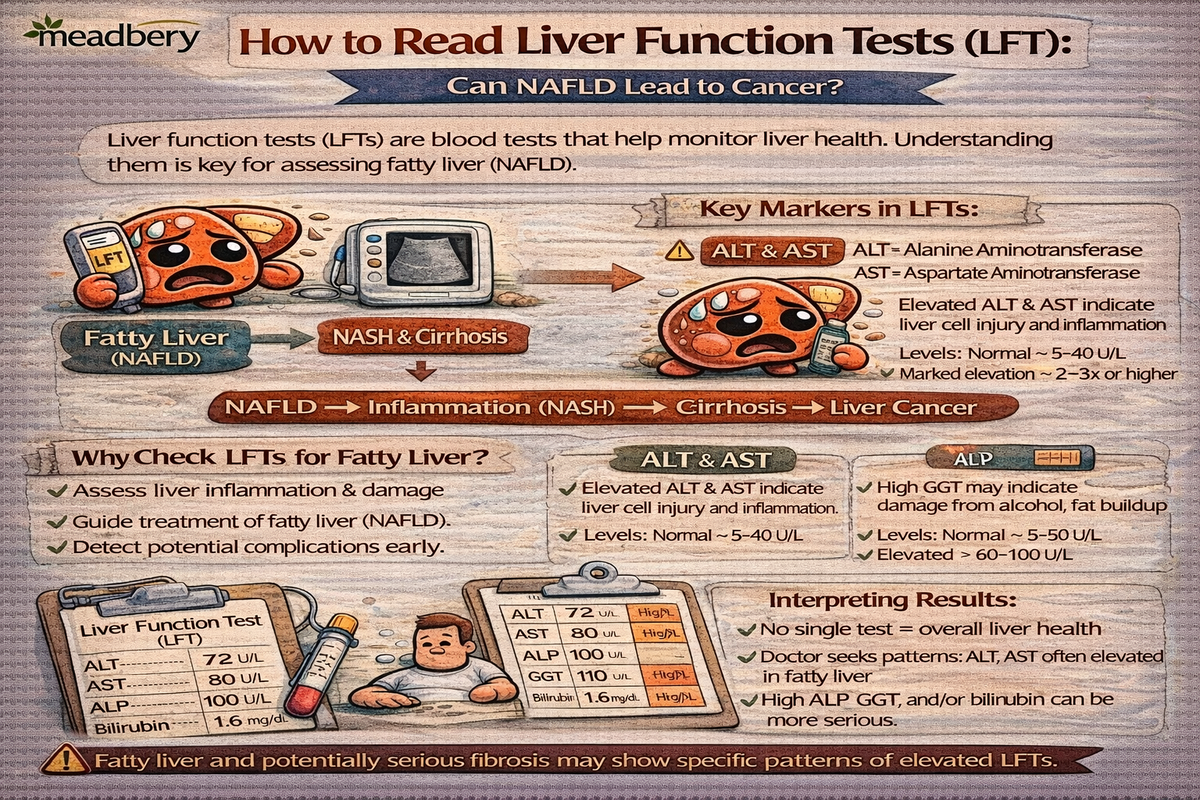
How to Read Liver Function Tests (LFT) for Fatty Liver
Liver Function Tests (LFT) are blood tests that help evaluate liver health. In fatty liver, LFTs may show mild enzyme elevation, but normal values do not always rule out disease. Understanding each parameter helps interpret reports more clearly.
Fatty liver foundation here:
https://www.meadbery.com/pages/fatty-liver-complete-fatty-liver-guide
NAFLD overview here:
https://www.meadbery.com/pages/nafld-complete-clinical-overview
Key LFT Components Explained
1. SGPT (ALT)
• More specific to liver
• Often elevated in fatty liver
• Indicates liver cell stress
Detailed explanation here:
https://www.meadbery.com/pages/fatty-liver-and-sgot-sgpt
2. SGOT (AST)
• Found in liver and other tissues
• May rise in fatty liver
• Less specific than SGPT
The AST/ALT ratio may help evaluate progression.
3. Bilirubin
• Measures breakdown of red blood cells
• Usually normal in early fatty liver
• May rise in advanced liver disease
Elevated bilirubin requires further evaluation.
4. Alkaline Phosphatase (ALP)
• Linked to bile flow
• Mild elevation may occur
• Significant elevation needs evaluation
5. Albumin
• Protein produced by liver
• Usually normal in fatty liver
• Low levels suggest advanced disease
Can LFT Be Normal in Fatty Liver?
Yes.
Many people with:
• Grade 1 fatty liver
• Early NAFLD
may have normal LFT results.
Imaging explanation here:
https://www.meadbery.com/pages/fatty-liver-stages-explained-with-imaging
What LFT Patterns Suggest Progression?
Persistent elevation of:
• SGPT
• SGOT
• Rising enzyme trends over time
may indicate inflammation (possible NASH).
NASH explanation here:
https://www.meadbery.com/pages/fatty-liver-vs-nash
LFT and Fibrosis Risk
LFT alone cannot detect fibrosis reliably.
Fibroscan or fibrosis scoring may be needed.
Fibrosis explanation here:
https://www.meadbery.com/pages/liver-fibrosis-in-fatty-liver
How Metabolic Markers Support LFT Interpretation
For complete evaluation, also check:
• HbA1c
• Fasting blood sugar
• Triglycerides
• Lipid profile
HbA1c link:
https://www.meadbery.com/pages/fatty-liver-and-hba1c
Triglyceride link:
https://www.meadbery.com/pages/fatty-liver-fatty-liver-and-triglycerides
Fatty liver is strongly metabolic.
When Should You Be Concerned?
Consult a doctor if:
• Enzymes rise significantly
• Bilirubin increases
• Symptoms appear
• Enzyme levels remain elevated long term
Progression risk overview here:
https://www.meadbery.com/pages/fatty-liver-vs-cirrhosis
Can LFT Improve?
Yes.
Improvement is often seen with:
• Sugar reduction
• Weight loss
• Exercise
• Alcohol avoidance
Weight loss link:
https://www.meadbery.com/pages/fatty-liver-and-weight-loss
Exercise link:
https://www.meadbery.com/pages/fatty-liver-and-exercise
Alcohol link:
https://www.meadbery.com/pages/fatty-liver-and-alcohol
Supporting Liver Health
Along with regular monitoring and strict metabolic correction, daily liver support may help reduce oxidative stress and support metabolic balance.
Explore a herbal liver support option here:
https://www.meadbery.com/products/fatty-liver-detox-natural-capsule
Frequently Asked Questions
Can fatty liver exist with normal LFT?
Yes, especially in early stages.
Which enzyme is more important, SGOT or SGPT?
SGPT (ALT) is generally more liver-specific.
Does high SGPT mean severe fatty liver?
Not necessarily; imaging is needed for grading.
Can LFT alone diagnose fatty liver?
No, imaging is required.
How often should LFT be repeated?
Follow medical advice based on severity and risk factors.